What you need to do
The practical activities and techniques you need to master – what to practice, what to get good at, and what to keep doing.

Market sizing: TAM, SAM, SOM
Estimate the total market (TAM), the portion you can realistically serve (SAM), and the share you can capture near-term (SOM). Use both top-down (industry reports) and bottom-up (target users × average spend) methods, then cross-reference. The value is in the thinking, not the precision of the number.

Market segmentation and targeting
Divide the market into distinct groups based on needs, behaviors, or demographics – then choose which segments to pursue. Use the STP framework (Segmentation, Targeting, Positioning) to connect who you serve with how you position yourself. Not every segment is worth fighting for.

Competitor identification and classification
Map direct competitors (same problem, same approach), indirect competitors (same problem, different approach), and substitutes (different problem, same budget). Most teams only track direct competitors and get blindsided by substitutes. Include non-consumption – people solving the problem manually or not at all.

UX flow mapping
Create detailed maps of competitor user flows and journeys – from signup through core workflows and edge cases. Document navigation patterns, interaction sequences, and decision points. Flow maps reveal product strategy and expose where competitors create friction or delight.

Pricing modelling and comparison
Model and compare competitor pricing strategies – flat-rate, per-seat, usage-based, freemium – across different usage scenarios. Build pricing models that show how costs scale for different customer segments. Understanding pricing architecture reveals which segments competitors prioritize and where pricing gaps create opportunity.

Trends and competitor monitoring
Set up ongoing monitoring of competitor moves, emerging technologies, regulatory shifts, and market trends that could disrupt your space. Combine automated alerts, periodic reviews, and environmental scanning to catch weak signals early. The goal is continuous awareness, not periodic deep dives.
Frameworks to know
The mental models and structured approaches that guide how you think about this skill – not rules to follow, but lenses to see through.

Porter’s Five Forces
Five structural forces that determine industry profitability: rivalry among existing competitors, threat of new entrants, threat of substitutes, bargaining power of buyers, and bargaining power of suppliers. The framework answers “why is this industry profitable (or not)?” rather than “who’s winning.” Use it to assess whether a market is worth entering. Most product teams skip it – and then wonder why a structurally unattractive market stays brutal regardless of execution quality.

Blue Ocean Strategy – Four Actions Framework
Instead of competing in crowded markets (red oceans), create uncontested market space (blue oceans) through value innovation. The Four Actions Framework guides product design: Eliminate factors the industry takes for granted, Reduce factors below the standard, Raise factors above the standard, Create factors the industry has never offered. The key shift: study non-customers (why people aren’t buying) rather than obsessing over existing customers and competitor features.

Feature parity comparison
A structured method for competitive benchmarking: list all features in a comparison table, then systematically check off whether you, each competitor, and substitute solutions offer each capability. The matrix reveals genuine differentiation gaps, feature parity areas, and opportunities where no player delivers. Update quarterly – feature matrices decay fast. The value isn’t in proving you’re better; it’s in seeing the landscape honestly.

Lean Canvas
Ash Maurya’s one-page business model adapted from the Business Model Canvas for startups and new products. Nine blocks completed in under 20 minutes: Problem (top 3 problems), Customer Segments (target users and early adopters), Unique Value Proposition (single clear message), Solution (top 3 features), Channels (path to customers), Revenue Streams (how you make money), Cost Structure (fixed and variable costs), Key Metrics (the numbers that matter), and Unfair Advantage (what can’t be easily copied). The canvas forces you to articulate and validate your business assumptions before investing in development.
Good vs. bad
Common mistakes paired with what experienced practitioners do instead – and why the product builder approach changes the game.



Market analysis is the most neglected product skill. Every PM talks about “user research” and “data-driven decisions.” Almost nobody does regular competitive analysis. They glance at competitors during strategy season, build a comparison table for the sales team, and then go heads-down on their own roadmap for months. Meanwhile, the market shifts.
You don’t need a strategy consulting background. The frameworks exist – Porter’s Five Forces, SWOT, Blue Ocean, STP. They sound academic, but they’re just structured ways to answer basic questions: Is this market worth being in? Who are we really competing against? What makes us genuinely different? You don’t need an MBA to ask these questions. You do need the discipline to ask them regularly.
The product builder advantage: you can feel the market, not just read about it. Traditional PMs analyze competitors from the outside – screenshots, marketing pages, pricing pages. A product builder who can code actually signs up for competing products, uses them, breaks them, reads their API docs, inspects their tech choices. That’s a fundamentally different level of competitive intelligence.
AI changed competitive intelligence from periodic to continuous. Before AI, a thorough competitive analysis was a multi-week project. Now you can get a solid competitive overview in an afternoon. Perplexity can synthesize public information about any company in minutes. Claude can analyze a competitor’s pricing page and explain the strategy behind it. The bottleneck isn’t information gathering anymore – it’s judgment.
The most important competitor is non-consumption. Most competitive analyses obsess over rival products. But the biggest market opportunity is usually the people who aren’t using any solution – spreadsheets, email, manual processes, or simply ignoring the problem. If you can convert non-consumers, you grow the market instead of fighting over existing share.
Porter’s Five Forces is the one framework that actually changes how you think. SWOT is too generic. Feature matrices are too tactical. But Five Forces forces you to ask structural questions about your industry that most product people never consider: Why do buyers have so much power? Why is it so easy for new competitors to enter? These aren’t product questions – they’re business questions. And they determine whether any amount of great product work will lead to a profitable business.
Go deeper
Books to deepen your understanding beyond what fits on this page.

The most accessible explanation of Porter’s Five Forces and competitive strategy. Not Porter’s own dense academic writing – Magretta distills it with real-world examples.
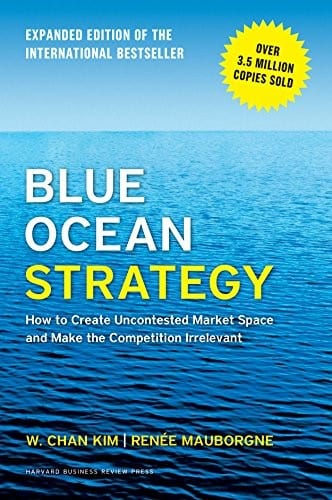
How to stop competing in crowded markets and create new ones. The Four Actions Framework and Strategy Canvas are directly applicable to product strategy.
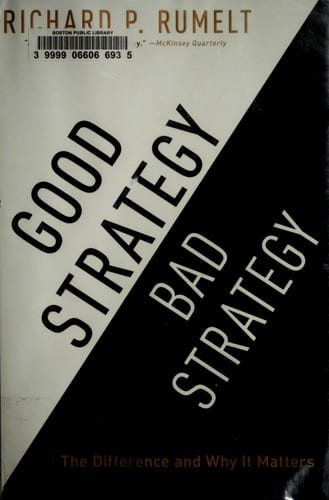
The best book on what strategy actually is – and what it isn’t. Rumelt’s “kernel” (diagnosis, guiding policy, coherent actions) cuts through the noise of strategic planning theater.

The practical guide to Lean Canvas and systematic business model validation – how to document, test, and iterate your business assumptions before building.